
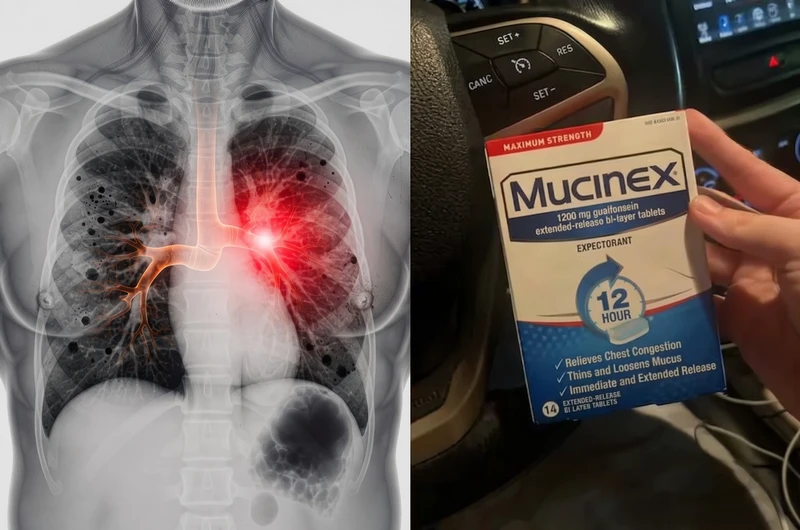
Evelyn Parker had spent months sleeping in a recliner chair. These days, she sleeps next to her husband again.
If you have ever woken up with thick mucus in your throat that you cannot cough up...
If you have spent twenty minutes every morning leaning over the bathroom sink, trying to clear your throat...
If you have had to stack three or four pillows on top of each other just to breathe comfortably when you lie down...
If you have been taking over-the-counter expectorants, herbal teas and supplements every day for months, but the mucus never seems to ease...
Then what one pulmonologist noticed after 15 years of practice may be worth reading.
There is a lesser-known issue that many people living with COPD run into.
It can leave them short of breath while the usual remedies sit in the bathroom cabinet.
I am talking about what some respiratory researchers describe as a deeper, settled layer — patients put it more simply: the mucus trap.
It is something that can settle deep in the airways and build up over time. It may be why mornings feel congested, why sleep is restless, and why three years of the usual remedies changed so little.
But this is not the surface mucus that your doctor treats.
It is the layer underneath that builds up over months...
It gets thicker and harder, while every treatment you try only touches what is on top...
While the usual prescriptions tend to work mainly on what sits on top.

The Doctor Who Refused to Watch Her Patients Suffer Without Answers
Dr. Barbara Miller worked for 15 years as a pulmonologist in Denver. Thousands of COPD patients. Every treatment plan followed exactly as recommended.
At first, her patients' condition would improve. Then the mucus would return. Then it would get worse.
"It's just COPD," her colleagues told her. "Chronic mucus production. We treat it with expectorants."
Dr. Miller agreed with this. Until Evelyn Parker arrived.
Evelyn was 64 years old. Stage 2 COPD. She did everything the doctors told her.
She took an over-the-counter expectorant every morning for over a year. Drank herbal tea every night. Tried various supplements and mucolytic capsules. Her doctor added a saline nebulizer twice a day. She bought a humidifier. Slept propped up on pillows.
Nothing helped.
Six months later, she returned looking exhausted. Dark circles under her eyes.
"I haven't slept a full night in four months. Every morning I wake up with this thick mucus that I can't get out. I sit and cough for twenty minutes, and almost nothing comes out."
Dr. Miller adjusted her dose and added more to the plan.
Three months later, the mucus got worse.
"I moved into a rocking chair," Evelyn said. "I can't sleep lying down. When I lie flat, it feels congested and I wake up. I take everything you told me to. Everything I read on the internet. But it isn't easing."
She had tried everything. Spent hundreds of dollars. And the mucus condition still kept getting worse.
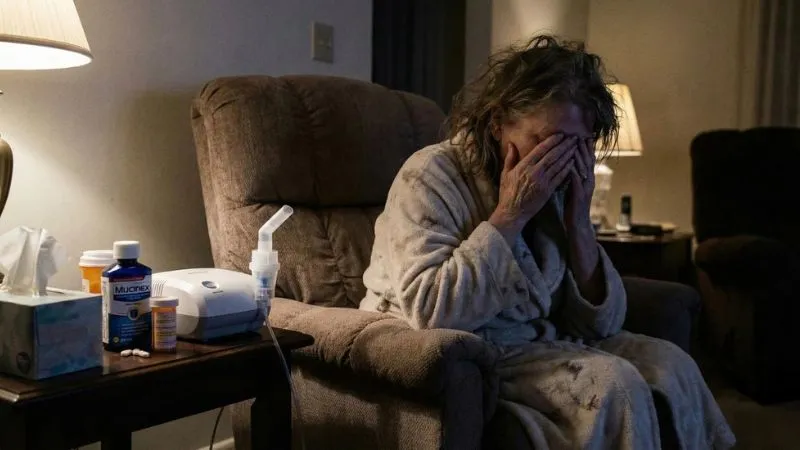
What One Medical Study Revealed at 2:30 AM
That night, Dr. Miller sat at her laptop, searching medical databases for something about chronic mucus she hadn't tried yet.
Then she came across published respiratory research looking at a small group of patients.
Researchers had examined airway tissue samples from people with long-standing COPD.
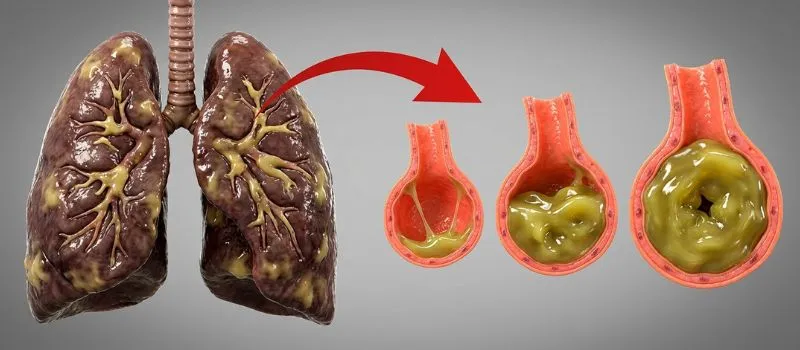
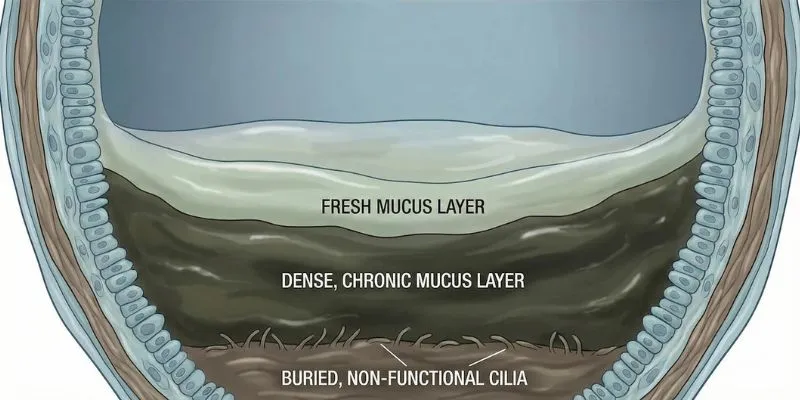
What they described: in the airways, a denser layer of mucus can sit underneath the fresh mucus — below where surface remedies tend to reach.
The layer had been there for months. Sometimes more than a year.
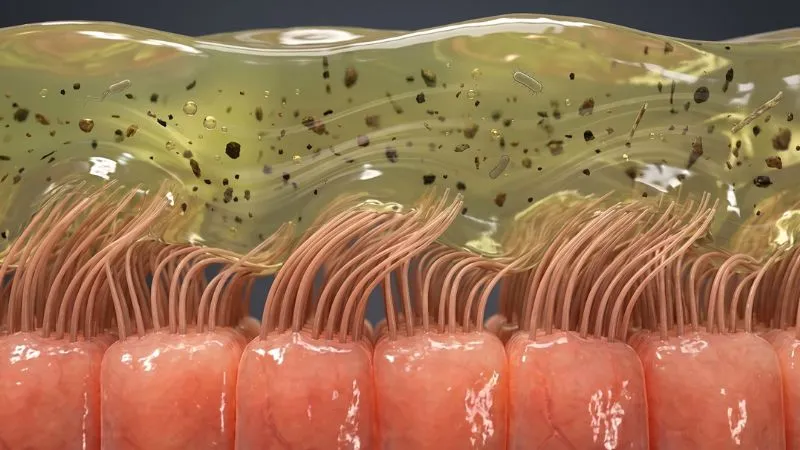
The cilia — those tiny hairs that sweep mucus out — were completely buried beneath it. Non-functional.
The researchers looked at how standard remedies acted on this deeper layer.
The usual options — expectorants, saline nebulizers and common supplements — appeared to act mainly on the surface.
The structure was described as denser, and surface remedies did not appear to break it down.
Dr. Miller looked back over the notes of patients who kept reporting congestion despite trying everything.
Most had been taking over-the-counter expectorants for months or years, had tried many remedies, and slept propped up.
And most said the congestion was not easing.
The usual approach seemed to help less than expected — because it works mainly on the surface.
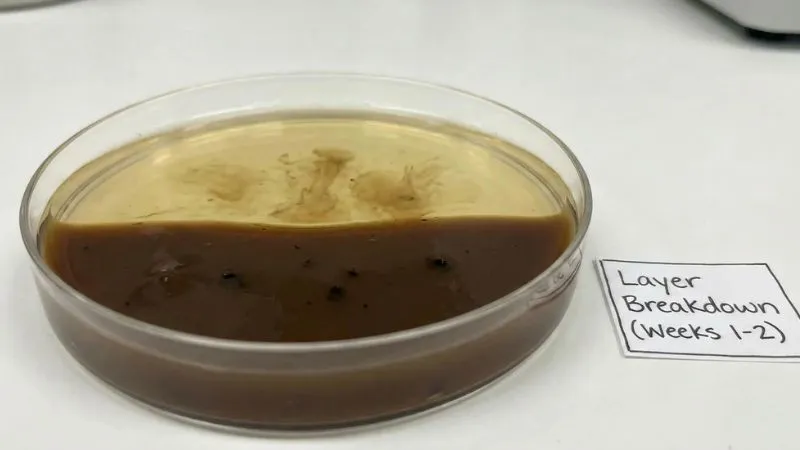
Why Surface Remedies May Not Reach the Deeper Layer
The next morning, Dr. Miller called Evelyn.
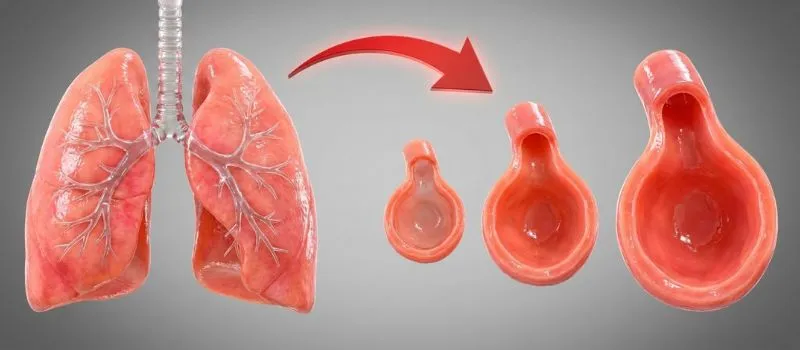
She showed her a diagram. "This is what you cough up every morning. Fresh mucus. An expectorant thins it. Your nebulizer helps with this."
Then she pointed below. "But beneath it, there is another layer. Old mucus. Months, maybe years old. Your cilia are buried under it."
"When you lie down, gravity shifts it upward and the airways feel more congested. That may be why mornings are hardest, and why what you tried helped less than you hoped."
Evelyn stared at the diagram. "But I take my expectorant every day. I do my nebulizer treatments."
Dr. Miller nodded. "And they help with the surface mucus. But here is what nobody tells you: you can thin the mucus you cough up, but you cannot thin the mucus you cannot reach."
She pointed to the bottom layer again. "There's the difference. Everything you've tried works on what you can cough up. But this layer sits deeper and is more compacted, so surface remedies tend not to reach it."
"Why has nobody told me this?"
"Because it isn't something we routinely look for, and it doesn't show up on a standard X-ray. So the usual approach stays focused on the surface."
"Can you remove it?"
"Not surgically. But there might be another way."
What Respiratory Therapists Have Known for Years
Dr. Miller turned to respiratory therapists. Asked what they believed helps when nothing else does.
One of them mentioned a patient who had been very congested. "He used some herbal capsules he ordered online. A couple of weeks later, he said his breathing felt much easier."
Another said she had tried them herself. "I tried the usual expectorants and supplements without much luck. Then I used these capsules, and after about a week my chest felt a lot clearer."
Each time, the same four ingredients: Papaya extract. Black walnut. Chlorella. Psyllium husk

Papaya extract
may help break down the mucin proteins that hold the layer together

Black walnut
may help soothe the irritation that makes mucus thick and sticky

Chlorella
may help the airways relax so mucus can clear more easily
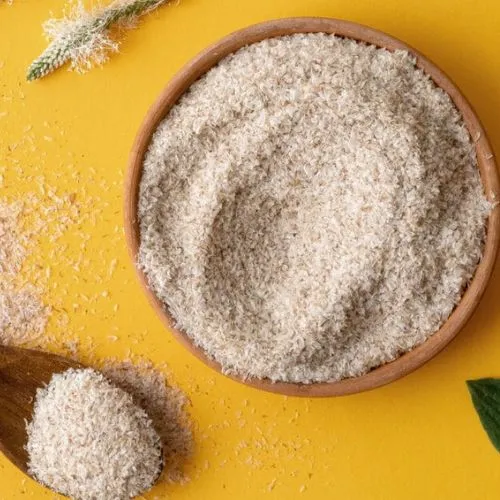
Psyllium husk
may support the airways' natural clearing process
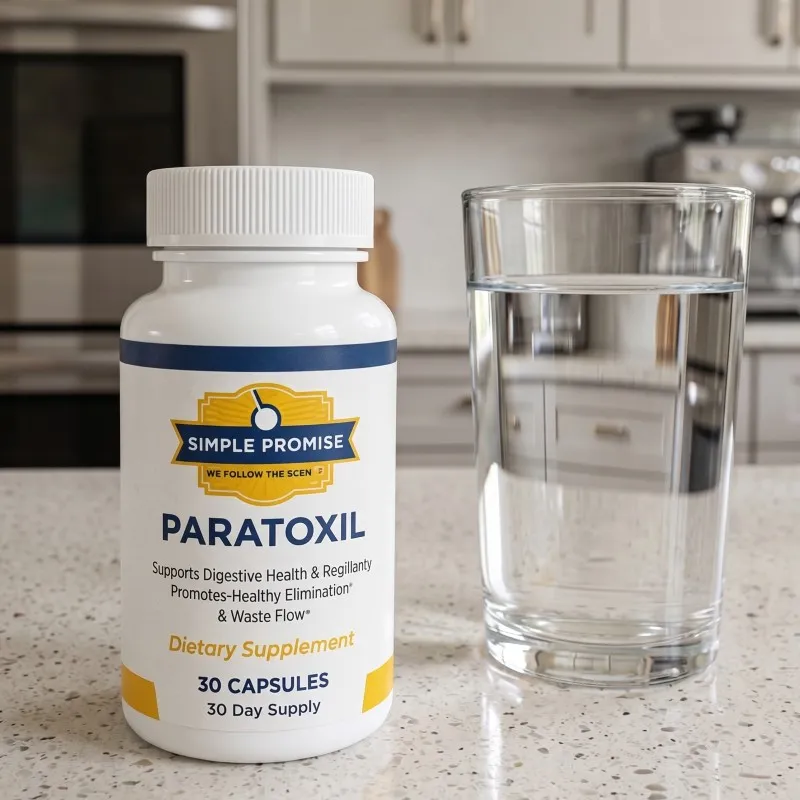
She found a company that manufactures concentrated Paratoxil capsules.
How to Properly Take Paratoxil?
One capsule on an empty stomach, every morning.
One full glass of water — at least 8 oz.
Repeat for 10 to 14 days, depending on how long the problem has been present.
Week One: What Many People Notice
Dr. Miller warned Evelyn what to expect.
"You may bring up more mucus than usual for a week or two. That is often the older, settled mucus starting to clear. Many people take it as a sign things are moving."
Evelyn started bringing up more mucus than usual.
"That is likely months of settled mucus finally clearing," Dr. Miller told her. "The expectorants and herbal teas were working on the surface. This is what was underneath."
On the 10th day, she filled a small trash can with tissues.
Week 3: Evelyn called. "I slept through the night. Not once did I wake up."
Week 5: "I lie flat. Next to my husband. Breathing easily."
Month 3: She sent a photo. Her and her husband smiling. Planning a trip.

Why This Is Not Widely Talked About Yet
Dr. Miller tried to take her observations further, but funding for this kind of research is hard to come by.
Most respiratory research funding goes toward established treatments, so gentler, plant-based approaches rarely get studied at scale.
An approach used for a short course simply does not fit the usual model of ongoing daily products.
But word spread. Support groups shared it. Patients got better.
Large-scale clinical trials are extremely expensive and take many years, which is out of reach for a small producer.
So it is offered as a respiratory support supplement — the same ingredients, available without a prescription.
Congestion Does Not Have to Be Something You Just Live With
You have two options.
Carry on with the usual expectorants, which work mainly on the surface. Or keep trying supplements that may not reach deep enough.
Or try what respiratory therapists use. What Dr. Miller's patients use.
Evelyn decided to try. Now she sleeps next to her husband again.
The sooner you start, the sooner your routine has time to work.
How Can I Purchase Paratoxil?
You must be a US resident and be 18 years of age or older. Paratoxil ships directly from our US warehouse via USPS or FedEx — usually within two to four business days.
Ordering is simple: answer three short questions below to claim your discount, and then click "Order Now" to reserve your supply on the official Paratoxil website. You confirm delivery on the next page — no card details are required to receive the offer.
Answer 3 Questions and Get UP TO 75% OFF!
1. How often do you wake up feeling exhausted, even after 7+ hours of sleep?
2. Do you notice shortness of breath that wasn't there 5 years ago?
For example: climbing stairs, walking fast, carrying groceries.
3. Your age?
Discussion
34 commentsI used Paratoxil and honestly feel like a different person. I only wish I had known years ago how much easier the cough and congestion could get after a course. Ordered for the whole family while the promotion is still active.
I read this story and froze — morning chest tightness and phlegm right after — that was exactly ME. I completed a month-long course, and breathing feels so much easier. The cough and shortness of breath have eased a lot for me. Just ordered two more boxes.
People, I didn't think anything would be wrong other than my smoker's cough. How wrong I was — snoring, chest pressure, constant fatigue, and then heartburn started as well. Took the capsules every day as directed. Within a couple of days my chest started to feel clearer, and I feel MUCH better.
Right after COVID, I felt pressure in my chest, and it never fully went away. A week after starting Paratoxil, I feel much better, and even after just a few days, I can breathe and sleep peacefully. I wish I had learned about Paratoxil sooner.
If this is such a good product, why isn't it in pharmacies? I've been spending money on cough syrups and phlegm pills for years. Why should it be any different now?
Fair question, Mavis. Most over-the-counter cough remedies work in one way — they ease the symptom or thin the phlegm. Paratoxil is a liquid taken daily to do two things at once: help the airways clear trapped mucus and soothe the irritated tissue that keeps producing it. It is sold directly from the manufacturer to remain affordable and control quality. It won't replace what your doctor recommends — think of it as support aimed at the tissue itself.
My husband suffered for years — cough, shortness of breath, and then coughing up mucus every morning. Smoked in his youth, worked surrounded by smoke. We couldn't afford expensive treatment, so we tried Paratoxil. After a few weeks, he breathes smoothly, and the morning urges have stopped. If your husband is a smoker, order it.
My tests confirmed leftover mucus in my lungs after a severe cold, and that's when the cough started. The doctors just shrugged, and I don't have the money to keep fighting this. Ordered Paratoxil at a discount — six weeks in, my mornings are much easier.
I work in the pharmacy field. People come in asking for this and we don't stock it — it's sold direct from the manufacturer rather than through stores. I still recommend Paratoxil to friends.
Never smoked a single day in my life, but I've always lived downtown, breathing in exhaust fumes. Constant cough, chest tightness, and shortness of breath too. Ordered Paratoxil. Shortness of breath and cough are almost gone.
Completed the course on the advice of a pulmonologist I know. It had a huge impact on my breathing and my sleep became smooth. I haven't been sick once this season either.
Dirty lungs are no joke, I know this from personal experience. If you have at least a couple of the symptoms listed in this article — cough, pressure, morning weakness — a proper cleanse wouldn't hurt. Especially for those of us over 50.
This is worth keeping at home if you're over 50. Fatigue, headaches and that nagging cough — since I started, they've eased a lot for me. I feel years younger.